TurboBlaze vs Ninja AF141: which single basket fits your routine?
COSORI offers more ways to set up a cook. Ninja keeps the function list short. The useful choice depends on what those differences do for your dinner.
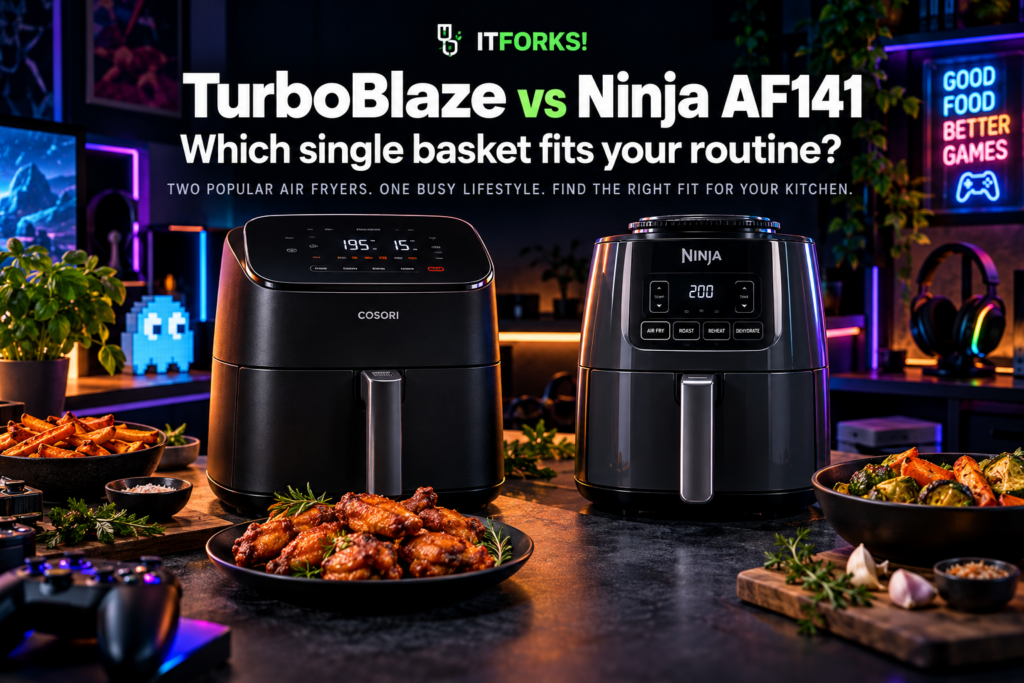
About the hero image: AI-generated conceptual comparison artwork. Appliance shapes and display details are illustrative, not authoritative photographs of the exact COSORI or Ninja models. No cooking outcome is an ItForks! test result.
ItForks! has not tested either appliance. This analysis compares manufacturer documentation with clearly attributed independent findings. No FORKS SCORE™ is assigned.
Nine functions versus four looks like an easy win until you remember that you cannot eat a function list.
The exact comparison here is the standard US COSORI TurboBlaze CAF-DC601-KUS against the US Ninja AF141. Not the connected TurboBlaze, not a regional AF141 variant, and not an XL Ninja hiding under a familiar name.
Both belong in the one-basket conversation. The decision is whether broader settings earn their place in your routine—or whether a shorter menu already covers it.
Extra modes should have a job
Ninja lists Air Fry, Roast, Reheat and Dehydrate for AF141. COSORI adds named Bake, Broil, Frozen, Proof and Keep Warm functions to its nine-function TurboBlaze menu. COSORI also says its five fan speeds follow the selected functions rather than being independently customizable. Ninja listing, COSORI listing.
That distinction matters more than the raw count. If you want a documented proofing workflow or baking mode, the COSORI menu has a clearer answer. If Air Fry and Reheat describe most of your week, the Ninja’s shorter list is not automatically a deficiency. A dedicated label is useful when its settings fit the task; it is not proof that another appliance cannot cook that kind of food.
Temperature belongs to a mode
The US AF141’s published ceiling is 400°F. The exact TurboBlaze US manual gives these relevant settings:
| TurboBlaze function | Manual setting range |
|---|---|
| Air Fry | 300–450°F |
| Roast | 350–450°F |
| Bake | 260–400°F |
| Dehydrate | 100–200°F |
| Proof | 90–110°F |
These are selectable ranges, not measurements of the food or guarantees of results. COSORI manual, printed p.14, Ninja AF141 listing.
The COSORI’s wider overall range is useful if you have a specific low-temperature or higher-temperature task. It does not mean every TurboBlaze mode reaches 450°F, or that the hotter setting is the right one for every meal. We have not verified complete official AF141 per-mode minima, so we are not filling that side of the table with numbers borrowed from another Ninja.
For a geek, this is the important upgrade question: do you need the supported operating range, or do you just like the larger number?
Independent evidence is useful—with the unit label attached
RTINGS’ AF141 review reports quick cooking and stable temperature behavior in its test. In its direct comparison discussion, the publisher describes faster preheating and cooking for Ninja, and more even cooking for the tested TurboBlaze. Both review pages identify the same methodology version. RTINGS AF141, RTINGS TurboBlaze.
There is an important boundary around the COSORI evidence: RTINGS says it tested a standard black TurboBlaze, and identifies PTFE on its tested plate while noting a later ceramic change. That is standard-platform context, not a fresh hands-on test of the current dark-gray CAF-DC601-KUS shipment. Its Wi-Fi version is separate, too. RTINGS variant and chamber sections.
Those findings help identify questions worth asking. They do not license “Ninja always gets dinner done faster.” Different food, loading, settings and retail generations can change the practical comparison. This article therefore offers no universal speed winner or copied reviewer verdict.
The coating footnote belongs in the buying decision
COSORI’s current CAF-DC601-KUS listing describes a ceramic-coated basket and crisper plate. Do not read an older PTFE test description as the specification of the unit you will receive. COSORI.
The COSORI manual permits dishwashing its removable basket and plate. The manufacturer-authored AF140-series guide supplied for AF141 also allows the basket and plate in a dishwasher, while recommending hand washing the basket for longevity. The appliance bodies are not dishwasher items. COSORI care section, Ninja guide reproduced by ManualsFile.
That establishes intended care, not which feels easier at the sink. RTINGS identifies ceramic on its AF141 plate; we have no ItForks! cleaning trial or long-term coating study to turn that into an ownership winner. RTINGS AF141 chamber section.
Choose the routine you will actually use
Investigate TurboBlaze if its documented extra modes and ranges solve a real task. Investigate AF141 if the four-function interface covers your routine and you prefer that narrower menu. Independent AF141 temperature findings are useful context, with the stated test limits.
Neither solves the basic problem of wanting incompatible main-and-side settings in separate zones. If that is your recurring frustration, the next decision is architecture, not another single-basket feature comparison.
We are not declaring a price winner: current comparable checkout availability, delivery costs and same-region totals were not established for both. The sensible purchase is the exact supported feature set you will use, at a local price you can verify—not the one with the longest menu.
Sources and context
All reference links are neutral. Manufacturer settings, independent observations and conditional editorial inference remain distinct. This is new comparative analysis, not a replacement for the existing TurboBlaze buying analysis.