Does a kitchen thermometer earn its drawer space?
A kitchen thermometer can fill a gap your air-fryer timer cannot. We examine Thermapen NANO, keeping a working ONE, and the everyday details beyond response speed.
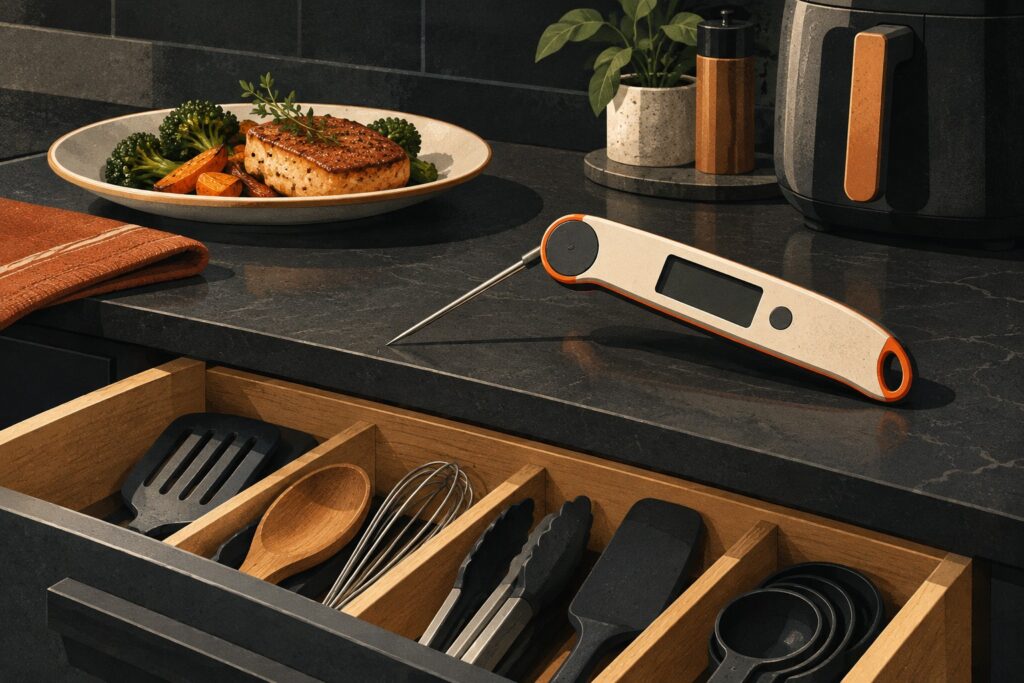
About the hero image: AI-generated conceptual illustration of a kitchen routine and a generic thermometer. It does not depict a Thermapen NANO or ONE, or an ItForks! product test.
Researched buying analysis · Sources checked 1 November 2026. ItForks! has not tested these thermometers. No FORKS SCORE is assigned.
Your air fryer knows the temperature you asked for. Your dinner is a different measurement.
That is the strongest argument for a food thermometer: it answers a question a timer and a browned surface cannot answer on their own. Before buying another cooking appliance, consider whether the missing upgrade is a way to check the food already coming out of it.
But needing a thermometer and needing a premium Thermapen are separate decisions. For an ordinary dinner, correct placement, a readable display and a probe you actually clean deserve as much attention as fractions of a second.
Start with the job
An instant-read thermometer suits a cook who wants to make spot checks and decide what happens next. A leave-in monitoring system serves a different routine: following a cook over time. Decide which question you need answered before comparing features.
Our buying interpretation: a thermometer earns its drawer space when checking becomes part of cooking, rather than something you remember after serving. If you routinely cook individual portions, the useful habit is checking the food you intend to serve. A faster tool can make that habit less irritating; it cannot do the thinking for you.
ONE is no longer the whole buying question
As checked on 1 November, ThermoWorks’ US navigation presents Thermapen NANO as new and Thermapen ONE as closeout. That establishes the US seller’s current presentation, not worldwide discontinuation. The standard ONE is the comparison here; do not borrow specifications from ONE Blue or another connected variant. ThermoWorks ONE listing.
The NANO’s manufacturer claims include 0.4-second response, a built-in magnet, a rotating backlit display and an accessible rear settings button. The US accuracy table specifies ±0.3°C from −20 to 120°C, ±0.4°C in the adjacent −50 to −20°C and 120 to 200°C bands, and ±1°C from 200 to 300°C. Its headline accuracy is therefore not a promise across the entire range. ThermoWorks NANO specifications.
The UK red NANO listing identifies product code 236-447, one AAA battery and an IP67 rating. Its accuracy table uses different bands from the US listing. We have not established whether this reflects a regional specification or a listing discrepancy; use the documentation for the exact unit you buy. UK NANO listing.
Our interpretation: the magnet and settings access may matter more to a daily routine than winning a speed comparison. A convenient storage position and readable screen are reasons to consider the newer model. They are not reasons to replace a working thermometer automatically.
What independent testing actually establishes
Bill McGrath’s AmazingRibs NANO review, updated 30 October 2026, reports that response was too fast for his method to quantify the lag. That is a useful observation, but it does not independently verify an exact 0.4-second result.
His published Fahrenheit checks show 32.0 at a 32-degree reference, 129.8 at 130, 224.7 at 225, and 324.2 at 325. Those are results for the reviewed unit at those points, not certification of every retail unit or every temperature. McGrath also notes the absence of a hold button. Read the original test and its method discussion.
Our conclusion is narrower than a superlative: the review supports taking NANO seriously as a fast spot-check tool. It does not establish that its extra speed changes your dinner enough to justify upgrading from ONE. We have not run a head-to-head test, measured time saved or established a lifetime reliability advantage.
The reading is only useful in the right place
UK government cooking guidance explains that cooking requires the centre of the food to reach an appropriate temperature for sufficient time. Its examples include 70°C for two minutes or 75°C for 30 seconds. It advises cleaning the temperature probe after each use to avoid cross-contamination. These are UK guidance examples, not a Greek regulatory statement or a complete chart for every food and cooking method. Cooking your food: official guidance.
For checking position, the Food Standards Agency’s probe guidance says to put the tip in the centre or thickest part. FSA probe-check instructions.
The practical implication: a quick number from the wrong location does not answer the centre-temperature question. Nor does the screen reaching a number establish that the food has spent the required time there. Use the relevant food-specific guidance and cooking instructions, rather than treating the display as an automatic safe-to-eat signal.
Cleaning, heat and the small print
The NANO manual identifies the sensor at the tip, specifies at least 3mm insertion and says to store the probe folded. That minimum concerns the sensor; it is not a reason to measure near the surface when the centre is the target. It also warns against rotating the probe beyond 180 degrees. Exact NANO operating instructions.
The UK product page says to clean the probe with warm soapy water and sanitise it with a food-safe probe wipe or sanitiser; it permits rinsing but says not to dishwash or leave it soaking. Its IP67 badge is not a shortcut past those care instructions. Manufacturer care guidance.
The manual warns that IPA and other solvents may damage the case and screen. It also cautions about its neodymium magnet near pacemakers and implanted medical devices. The five-year guarantee covers component or workmanship defects, with six months for the probe and exclusions including misuse and wear. Read the regional terms before buying. NANO manual and guarantee.
Do not mistake the probe’s measurement range for the body’s heat tolerance. The UK listing gives the instrument an operating range of −20 to 50°C. This is a handheld checking tool, not something to park inside an air-fryer drawer or oven. UK operating specifications.
Buying from Greece: confirm the route before the colour
We have verified UK and US manufacturer pages, not Greek checkout stock, delivered cost or a Greek service arrangement. Ask the seller to confirm the exact model, dispatch date, delivery charges, return route and who handles warranty service. An accessible listing is not proof that an order can be delivered to you now.
We omit a live price comparison because regional costs and availability have not been matched. For ONE, a closeout label alone is insufficient: compare the actual supported offer with NANO before treating it as a bargain.
Buy, keep or consider another approach
- Consider NANO if you need a first premium instant-read thermometer and value its storage, display and settings features. Confirm regional supply and support before choosing it.
- Keep a working ONE if it already gives you dependable checks. This research does not establish a compelling replacement case based on speed alone.
- Consider ONE conditionally if the exact local offer, documentation and support make sense. US closeout language does not establish your regional deal.
- Choose a different tool category if you need continuous monitoring. Start with that requirement rather than expecting a handheld spot-checker to fill it.
The best reason to buy is a gap in your cooking routine. The best reason to spend more is a feature that helps you close that gap repeatedly.
That is the same whole-routine question behind our AeroPress Original buying analysis. Use The Counter Space Check to think about storage and attention as well as footprint. Our Editorial Standards explain how researched analysis differs from testing.
GEEK OUT. EAT WELL!