One basket, two baskets, or a smarter dinner?
Start with the meal you keep trying to make. Drawer count, glass containers and food probes solve different problems—and none of them washes itself.
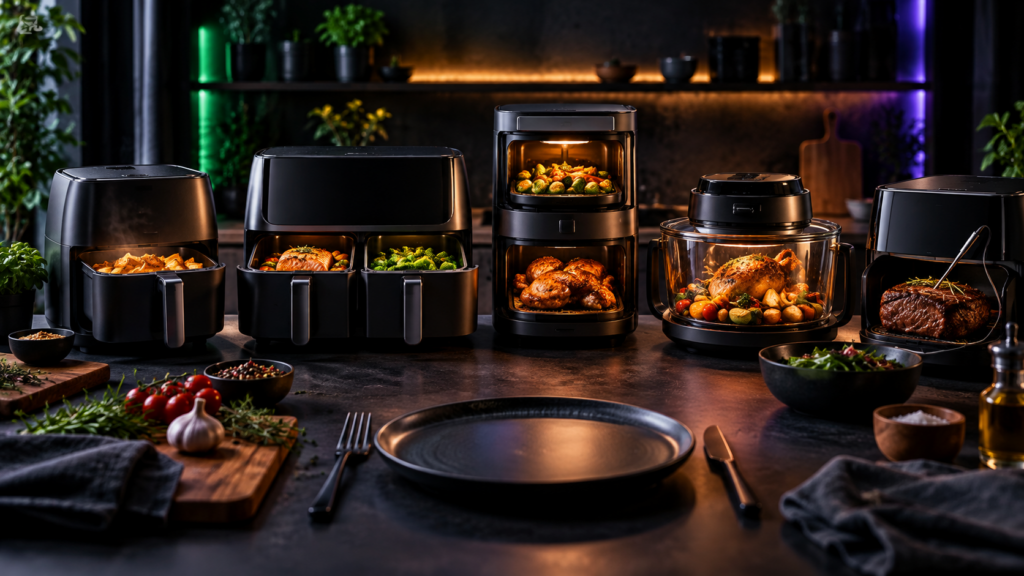
About the hero image: AI-generated conceptual illustration of cooking architectures. The illustrated appliances are not exact Product photographs, and the pictured food is not an ItForks! test result.
This is researched buying analysis. ItForks! has not tested these appliances. Manufacturer documentation describes intended operation; independent findings are attributed. No FORKS SCORE™ is assigned.
Different jobs. Different configurations.
Not an upgrade ladder. Find the setup that fits your dinner.
01 / Cooking conditions
Single basket
One batch. One shared set of cooking conditions.
Dual basket
Separate zones for foods needing different settings.
02 / Space & containers
Stacked baskets
Two zones arranged vertically; check usable space.
Glass containers
Consider handling, storage and reheating workflow.
03 / Feedback
Sensor-assisted
Probe or sensor feedback can help inform doneness decisions. Check what the specific model supports.
Your dinner has a workload. The appliance box has a feature list. They are not always talking about the same thing.
A snack after work, a main with a separate side, and a batch of food you want to store are three different jobs. Start there. Otherwise you can buy an impressively complicated answer to a question your kitchen never asked.
One basket: keep the problem small
If dinner usually means one batch at a time, a single basket is a sensible starting point. The US Ninja AF141 has four functions; the standard US COSORI TurboBlaze CAF-DC601-KUS has nine. Those are manufacturer feature lists, not a count of how many dinners either makes well. manufacturer listings, COSORI.
A single drawer also gives you one shared set of conditions. A main and side that need incompatible settings may require sequencing or another cooking method. That is a workflow limitation, not a reason everyone should buy two baskets. Ask how often it actually interrupts dinner.
Two baskets: buy coordination when you need coordination
The useful question is whether you need separate cooking zones. If your main and side usually share a temperature and finish time, a second drawer may add cost and cleanup without solving a real problem. If they routinely need different settings, independent controls and coordinated finishing become worth investigating.
Two separately controlled drawers are interesting when the main and side need different treatment. The US Ninja DZ550 supplies two 5-quart baskets. Tech Advisor describes a 6-litre drawer and a 3-litre drawer in its European Philips review. These differently sourced layouts illustrate portion splits, not a transatlantic performance contest. Ninja, regional Philips review.
Finish synchronization addresses coordination; it does not prove dinner takes half as long. Treat it as help with the finish line, not a universal speed upgrade.
Equal drawers make sense to investigate when both parts of the meal want similar space. Unequal drawers are worth investigating when the main routinely dominates. Neither arrangement knows your appetite.
A tower changes the shape of the compromise
Ninja’s US SL201 stacks two 4-quart drawers vertically. That is a distinct layout, not simply a larger single basket. manufacturer.
If counter width is the problem, a vertical design belongs on the investigation list. If cabinet height, depth or drawer-opening room is the problem, stacking may move the constraint rather than remove it. We are not making a fit recommendation from the disputed dimensional data in our research pack. Measure the operating space against the exact manual before committing.
Glass changes the container workflow
The US Ninja Crispi Pro AS101CY includes 6-quart and 2.5-quart glass chambers, crisper plates and storage lids. They are alternative chamber sizes for the appliance, not two independently running zones. manufacturer.
That makes the right question about containers: do you want a cooking-and-storage workflow, and do you have room for the spare glassware? Visibility can be appealing without being a performance guarantee. Follow the supplied handling and cooling instructions; a storage lid does not license any hot-to-cold transition you can imagine.
Sensors answer a different question again
A probe is food-temperature feedback, not another drawer. The DZ550 manual restricts its integrated thermometer to Zone 1. Dreo’s original US ChefMaker DR-KCM001S is the sensor-and-water candidate in this database; Dreo lists a cook probe and water tank, and its app FAQ says a sent cooking task needs confirmation on the appliance. Ninja owner guide, Dreo documentation.
Investigate these systems if setting a target is more useful to you than setting another timer. Allow for setup and care. We have not established that either reduces active interaction for your meal, and a connected feature is not permission to leave cooking unattended.
For one load, investigate one basket. For incompatible main-and-side settings, investigate independent zones. For constrained width, investigate vertical layout without assuming it fits overall. For container reuse, investigate glass. For food-temperature feedback, investigate sensors—and their setup requirements.
Choose the job before the gadget
Then count what happens outside the cook cycle: preparing food, opening drawers, handling hot parts, storing accessories and cleaning. None of those disappears because the screen has more icons. These are decision prompts, not measured ItForks! workloads.
That is why a geek should care: a good system matches its inputs, workload and constraints. The most interesting hardware is not automatically the hardware your dinner needs.
Sources and disclosure
Source links above are neutral reference links. Intended functions come from the makers; the conditional routing is ItForks! editorial inference, not test results. No prices, comparative timings, quietness ranking or universal winner are asserted.