Do you actually need two baskets?
Separate drawers can help a main and side reach the table together. First decide whether you need equal portions, unequal portions—or simply less appliance to clean.
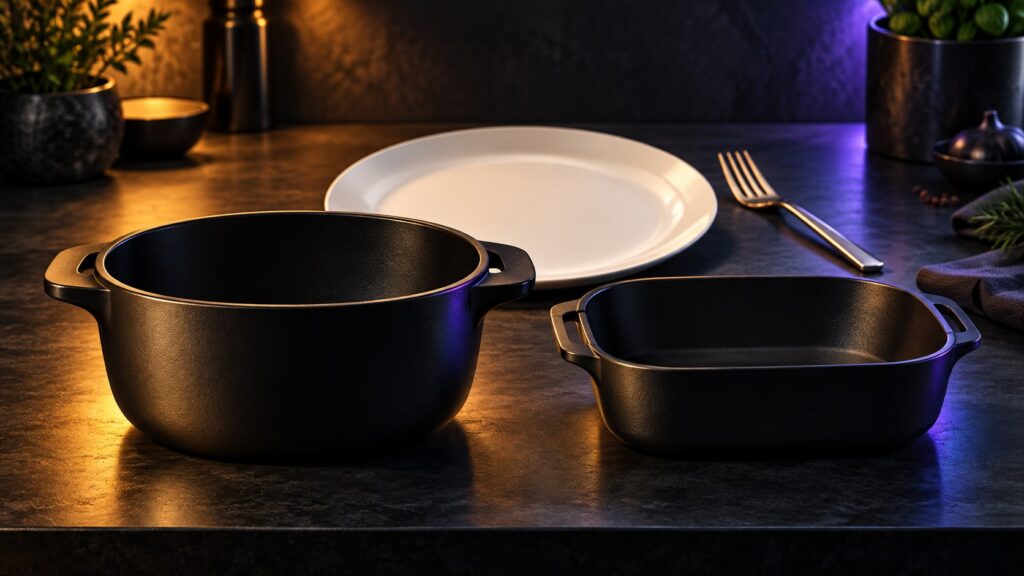
About the hero image: AI-generated conceptual illustration of separate cooking workflows. The vessels are symbolic; this is not a photograph of a specific dual-basket air fryer or an ItForks! cooking test.
Researched analysis, not an ItForks! hands-on test. Intended operation is sourced to manufacturers; reviewer observations are attributed. No FORKS SCORE™ is assigned.
The second basket sounds useful when one part of dinner is ready and the other still needs a turn. It sounds less useful when you are looking for somewhere to wash it.
The worthwhile upgrade is separate control for a problem you actually have. More drawers are not a reward for reaching a higher kitchen level.
Start with the split on your plate
Our two examples deliberately have different layouts. The US Ninja DZ550 provides two 5-quart baskets. For the UK/European Philips NA350/00 route, Tech Advisor reports 6-litre and 3-litre drawers in its regional review. The numeric split here is attributed review evidence: the maker advertises unequal drawers, but its full exact-European documentation was not retrievable in this refresh. Ninja, regional Philips review.
Equal drawers are worth investigating when both parts of dinner ask for similar room. An unequal split is worth investigating when one main dominates and the side is smaller. If both foods require a large spread-out layer, a smaller second drawer may become the constraint.
This is an architecture comparison across regions. These models are not interchangeable local shopping alternatives. We are not comparing their rated power to decide which uses energy better, pooling performance tests, or declaring a cross-market bargain.
Copying settings and coordinating a finish are different jobs
Ninja’s Match Cook applies matching settings across zones. Smart Finish coordinates different programmed cooks; its non-probe instructions start the longer program and hold the shorter one before it begins. The same guide includes single-zone cooking. DZ550 owner guide, printed pp.8–10.
That distinction is useful. One function repeats a setup; the other schedules it. Neither can make an incorrect cooking time become a correct one. A common finish signal is not a measurement proving two foods are done identically.
Philips advertises synchronized finishing for NA350/00; Tech Advisor also describes a copy control. We distinguish the maker’s intended scheduling feature from how the reviewer found the controls behaved. Philips model information, regional review.
But intended function and ease of operation should stay separate. Tech Advisor’s regional review reports awkward controls and says copying did not produce identical durations in its drawer workflow. We are retaining that observation rather than pretending the feature name resolves it. Read the instructions for the unit you buy and check the selected settings on each drawer. Tech Advisor.
For the same reason, “independent drawers” should not be read as “identical speed at every load.” Choose them for separate treatment and coordination; do not buy on an assumption that they halve dinner time.
The power-management footnote matters
Ninja’s DZ550 listing describes IQ Boost as power distribution across baskets when Match Cook and Smart Finish are not selected. That condition matters: the names are not a collection of benefits you can necessarily stack together. manufacturer.
We have not established a compatible full-load, simultaneous-zone benchmark for these exact regional examples. A fast result from one basket or one food is not a promise for two loaded drawers. That is a limit of the available evidence, not a reason to dismiss two zones.
Volume can hide the next bottleneck
Two drawer capacities added together tell you the nominal total. They do not create one continuous cooking floor.
Tech Advisor’s Philips review found the smaller drawer limited for arranging food and reported a substantial counter footprint. Those are observations from that reviewer’s appliance and workload, not measurements or cooking experience by ItForks!. regional review.
The practical question is whether your two loads fit separately. You cannot borrow unused room from the other drawer as though the divider disappears. A single larger basket can remain the more appropriate arrangement for a meal that mainly needs one spread-out load.
Two baskets can still mean one basket tonight
The DZ550’s documented single-zone operation means you do not have to run two cooks for every snack. It does not mean you can forget the physical space taken by the second drawer.
Philips’ review describes setting one drawer’s time and temperature, but this research refresh did not retrieve a usable exact-European manual sufficient to confirm every one-zone/pause constraint. We therefore make no more detailed promise for NA350/00.
Cleaning also has component boundaries. Ninja’s manual allows baskets and crisper plates in a dishwasher, recommends hand washing baskets for longevity, and excludes the thermometer from dishwashing or immersion. Tech Advisor reports dishwasher-safe drawers/inserts for its Philips review unit; that is attributed review evidence, not a freshly verified universal accessory-care rule. Ninja guide, Philips review.
If you use both drawers, plan for both sets of used parts. Dishwasher compatibility does not make their storage, loading or care disappear. We have not timed cleanup.
A 30-second decision check
Before paying for a second drawer, run through your last five dinners. Did you actually need two different temperatures or finishing times, or did you just want a bigger cooking area? A dual-basket appliance helps with the first problem; two smaller zones can make the second harder.
- Two foods, two settings, same mealtime: investigate synchronized dual-zone cooking.
- Two similar-sized loads: investigate equally sized drawers and check usable floor space.
- One large main and one small side: consider unequal drawers, but measure the smaller compartment against your usual portion.
- Mostly one food at a time: a single basket may be the simpler purchase.
- Limited counter or cleanup tolerance: measure the footprint and count the removable parts before deciding.
For the other side of the decision, read our single-basket TurboBlaze buying analysis. The comparison is about workflow, not a claim that we have tested these appliances ourselves.
Buy the coordination you need
Two baskets deserve consideration when incompatible main-and-side settings are a recurring problem. Investigate equal drawers for similar-sized loads and an unequal split for a larger main with a smaller side. Check the controls, exact manual and local model before treating the layout as a complete answer.
Stay with one basket if most dinners are one load, another appliance already handles the side, or occasional sequencing bothers you less than the extra counter and cleaning commitment. That is a conditional decision, not a consolation prize.
Why should a geek care? This is resource allocation: two queues, separate settings, a shared finish. Useful scheduling can earn its hardware. It does not need a fake speed trophy.
Still weighing the broader kitchen setup? Read our guide to single baskets, dual baskets, stacked drawers, glass containers and sensor-assisted cooking.
Sources and disclosure
Neutral source links appear beside factual claims. No price, energy-efficiency or universal cooking winner is asserted.